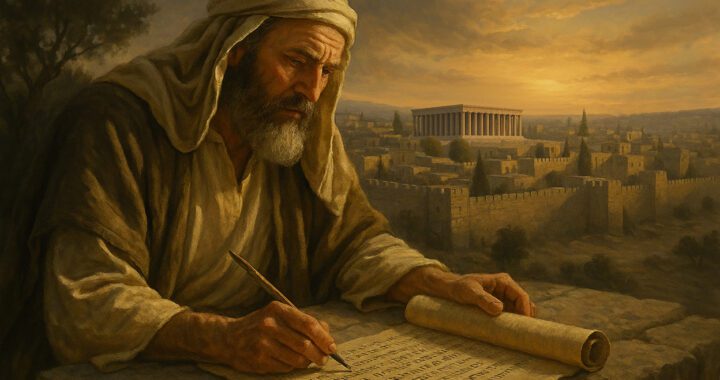
The Prophet Ezekiel was called to an unusual but important ministry to the captives of Judah in Babylon. Despite his unusual methods (e.g., symbolic acts) and extraordinary visions (e.g., Ezek 40–48), his overall message is clear and provides insight into God’s plan for Israel.
The Context of Ezekiel’s Prophecy of the Two Sticks
Ezekiel was taken captive in the second wave of the Babylonian Captivity when King Jehoiachin was taken captive in 597 BC (Ezek 1:2). Ezekiel then spent the remainder of his life in exile in Babylon, ministering to the captives that lived by the river Chebar (1:1, 3). While the elders of Israel came to Ezekiel for counsel (e.g., 14:1-3), they were largely unresponsive to his message.
Ezekiel’s book is laid out primarily in chronological order.1 The first part of Ezekiel’s book contains primarily prophecies of judgment upon Judah (Ezek 4:1 – 24:27) with a brief section containing oracles of judgment against the foreign nations (chs. 25–32). A major turning point occurs, however, with the fall of Jerusalem (33:21). After this point, Ezekiel’s ministry turns to providing hope of restoration for the captives of Judah (chs. 33–48).
Among the notable prophecies in the second half of Ezekiel’s book are the vision of the valley of dry bones (Ezek 37:1-14) and the prophecy about Gog of the land of Magog (chs. 38–39). Sandwiched between these sections is a symbolic act which Ezekiel performed and a corresponding oracle explaining the symbolic act: the prophecy of the two sticks (37:15-23).
The Content of Ezekiel’s Prophecy of the Two Sticks
Ezekiel 37 begins with the vision of the valley of dry bones (Ezek 37:1-14). In this prophecy, the nation, which is lifeless and without hope (cf. v. 11), is supernaturally brought back to life and vitality (cf. v. 12). The prophecy of the two sticks complements this vision of hope and identifies several specific elements that will comprise God’s future blessing upon the nation of Israel.
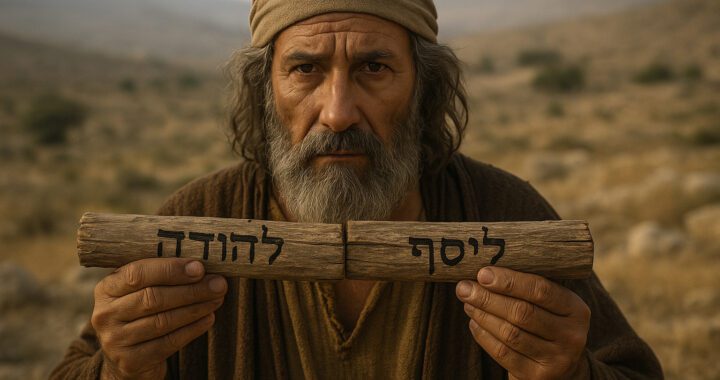
The symbolic act associated with the prophecy of the two sticks is straightforward (Ezek 37:15-20). The LORD tells Ezekiel to take two sticks and write the names of the Israelite nations upon them (v. 16). On one stick the prophet was to write “For Judah” which was the southern kingdom after the division of Israel in the days of Rehoboam (cf. 1 Kgs 12:1-24). On the other stick the prophet was to write “for Joseph,” representing the northern kingdom, Israel. Ezekiel refers to the northern kingdom as “Joseph” and “Ephraim” (Ezek 37:16) because the tribes from the sons of Joseph (i.e., Ephraim and Manasseh), and especially Ephraim, were very influential tribes in the northern kingdom.
Ezekiel was then to bind the two sticks together and to treat them as one stick (v. 17). The LORD instructed the prophet to tell the people that this act symbolized the reunification of the two nations into one “stick” or nation (v. 19).
The corresponding oracle (e.g., “Thus saith the Lord GOD,” v. 21) provides very specific details about His future plans for Israel as a nation.2 The elements of future blessing that the LORD promises to Israel in the prophecy of the two sticks tie together several strands of prophetic teaching concerning Israel and argue that God has an eschatological role for Israel.
1. The Complete Regathering of Israel (Ezek 37:21)
The first element of blessing that the LORD identifies in His future plans for Israel is regathering. The LORD promises to “gather them on every side, and bring them into their own land” (Ezek 37:21). This is a complete reversal of the dispersion of Judah that had taken place at the hands of the Babylonians and the deportation of the northern kingdom, Israel, at the hands of the Assyrians. The LORD would “undo” the judgment that the people had experienced because of their disobedience.
While the LORD did allow the captives in Babylon to return in the postexilic period (as recorded in the books of Ezra and Nehemiah), this was far from a complete regathering. While the returns from captivity in the Persian period may be a prelude to the hope that the LORD promised Israel, those returns do not exhaust the prophetic promises of a complete regathering of the nation of Israel (e.g., Jer 23:3; 32:37; Ezek 11:17; 20:41; 34:13).
2. The Permanent Reunification of the Nation (Ezek 37:22)
The promise of regathering is preparatory for the promise of the reunification of the nation (Ezek 37:22). This element of the oracle actually relates directly to the symbolic act Ezekiel performed (vv. 16-17). After the split of the kingdom during Rehoboam’s reign, Israel in the north and Judah in the south were distinct political entities.
The prophecy of Ezekiel foresees a reversal of this traumatic division. The healing of the breach would be complete and enduring. They would be “one nation” and they would “no more be two nations,” never to be divided into two kingdoms again (Ezek 37:22). The people of Israel to date have never experienced the type of regathering and complete reunification that the LORD promised through Ezekiel.
3. The Spiritual Renewal of the People (Ezek 37:23)
The LORD’s promises to Israel are not merely physical but also contain spiritual elements. The LORD promises that a time will come when the nation will be cured of idolatry, the people will be cleansed, and they will acknowledge the LORD as their God (Ezek 37:23). Thus, the nation will not only be physically restored but will be living in covenant fellowship with the LORD.
Israel had a long history of rebellion against the LORD. This, in fact, led to the dispersion that the people had just experienced. However, the prophets saw a time when the people would be renewed in their commitment to the LORD, forgiven of their sin, and obedient to His rule. As with other elements of this prophecy, the people of Israel have never experienced this type of spiritual renewal, which is an important part of God’s future promises for Israel (Ezek 11:20; 14:11; 36:28).
4. The Eternal Rule of a Davidic Ruler (Ezek 37:24-25)
The Divine oracle that explains the binding of the two sticks also promises a Davidic ruler, reigning over His people (Ezek 37:24-25). Ezekiel specifically identifies this ruler as “David” (in both verses 24 and 25; cf. Jer 30:9; Hosea 3:5). Some interpreters take this as a reference to the resurrected David3 while others take it as a reference to David’s descendant, the Messiah.4 While the latter view might be slightly more likely, it is entirely possible that David will have a role to play in God’s kingdom program. Either way, this everlasting Davidic rule has not been experienced by Israel. It represents another future expectation for Israel.
5. The Perfect Reception of Peace (Ezek 37:26)
Another element of God’s promise to Israel is that they would live in complete peace (Ezek 37:26). The LORD will establish “a covenant of peace” with Israel. This covenant will involve dwelling in the land with God in their midst (v. 26). This covenant will be everlasting (v. 26). The covenant in view here is probably not one of the great covenants that God has made with Israel (e.g., the Abrahamic Covenant or Davidic Covenant) but the peace that will result from the provisions of those covenants.5 This aspect of God’s promise has obviously not been experienced in the history of ancient or modern Israel. Peace has always been elusive for the nation of Israel, but it represents an important prophetic expectation for national Israel.
6. The Personal Relationship with God (Ezek 37:27-28)
A final element of Ezekiel’s prophecy is that the LORD would dwell personally with His people (Ezek 37:27-28). The LORD’s “sanctuary” (v. 26) and “tabernacle” (v. 27) would physically be present among the people, indicating that He will be worshipped (i.e., in the millennial temple; cf. Ezek 40:1–44:31). The people would eternally recognize the LORD, giving testimony to the Gentiles (37:28). Israel has not experienced this personal presence of God coupled with complete covenant faithfulness.
The Implication from Ezekiel’s Prophecy of the Two Sticks
As we consider Ezekiel’s prophecy of the two sticks, several implications arise that have direct impact upon God’s future plans for Israel.
1. God Does Not Make Vain Promises
Ezekiel 37:15-28 identifies several elements of blessing that God declared that He would accomplish for His people. These promises were not dependent upon the people but upon the LORD’s ability and intent to fulfill His promises.
God is not able to lie (Titus 1:2; Heb 6:18). When God makes a promise, He fully intends to complete that promise in the way that it was intended. Anything less calls the character of God into question. God does not make vain promises or promises that He cannot keep. Knowing the future and the character of Israel, the LORD made promises to Israel that He fully intends to fulfill in His eschatological program.
2. God Has Not Fulfilled Ezekiel’s Prophecies
As one considers the prophecy of the two sticks, the elements of the prophecy have not been fulfilled in the nation of Israel to date. Neither the post-exilic community nor the modern state of Israel experienced the complete restoration, peace, or complete covenant fellowship that this passage envisions. The people have not been unified under a Davidic ruler and God is not personally dwelling among the people.
3. God Has a Future Plan for Israel
The final conclusion is that Israel indeed does have a role in God’s eschatological plan.6 God is not finished with Israel. The LORD has made promises to the nation, which He is fully able to complete. These promises have not been fulfilled as stated in the historical nation of Israel (post-exilic or modern), but I believe that God will fulfill these promises to the nation of Israel in the eschatological events that God has outlined in Scripture.
This article first appeared in Frontline magazine, 2024. Used with Permission.
Works Cited- See the chart of dates in Ralph H. Alexander, “Ezekiel,” in The Expositor’s Bible Commentary, rev. ed., vol. 7. Jeremiah–Ezekiel, ed. Tremper Longman III and David E. Garland (Grand Rapids: Zondervan, 2010), 647.[↩]
- Lamar Eugene Cooper (Ezekiel, The New American Commentary, vol. 17 [Nashville: Broadman & Holman, 1994], 327) identifies thirteen promises for Israel in this passage.[↩]
- Charles H. Dyer, “Ezekiel,” in The Bible Knowledge Commentary, vol. 1, ed. John F. Walvoord and Roy B. Zuck, vol. 1 (Wheaton, IL: Victor, 1985), 1295.[↩]
- Alexander, “Ezekiel,” 851.[↩]
- Cf. Alexander, “Ezekiel,” 851; Dyer, “Ezekiel,” 1295.[↩]
- See especially Alexander, “Ezekiel,” 847 and Cooper, Ezekiel, 328.[↩]

Dr. Keith Kobelia
Keith A. Kobelia (PhD, Dallas Theological Seminary) has taught in the Bible and Theology Department at Faith Baptist Bible College since 2014. He, his wife, Elizabeth, and their six children reside in Ankeny, Iowa.
Dr. Keith Kobelia
Keith A. Kobelia (PhD, Dallas Theological Seminary) has taught in the Bible and Theology Department at Faith Baptist Bible College since 2014. He, his wife, Elizabeth, and their six children reside in Ankeny, Iowa.