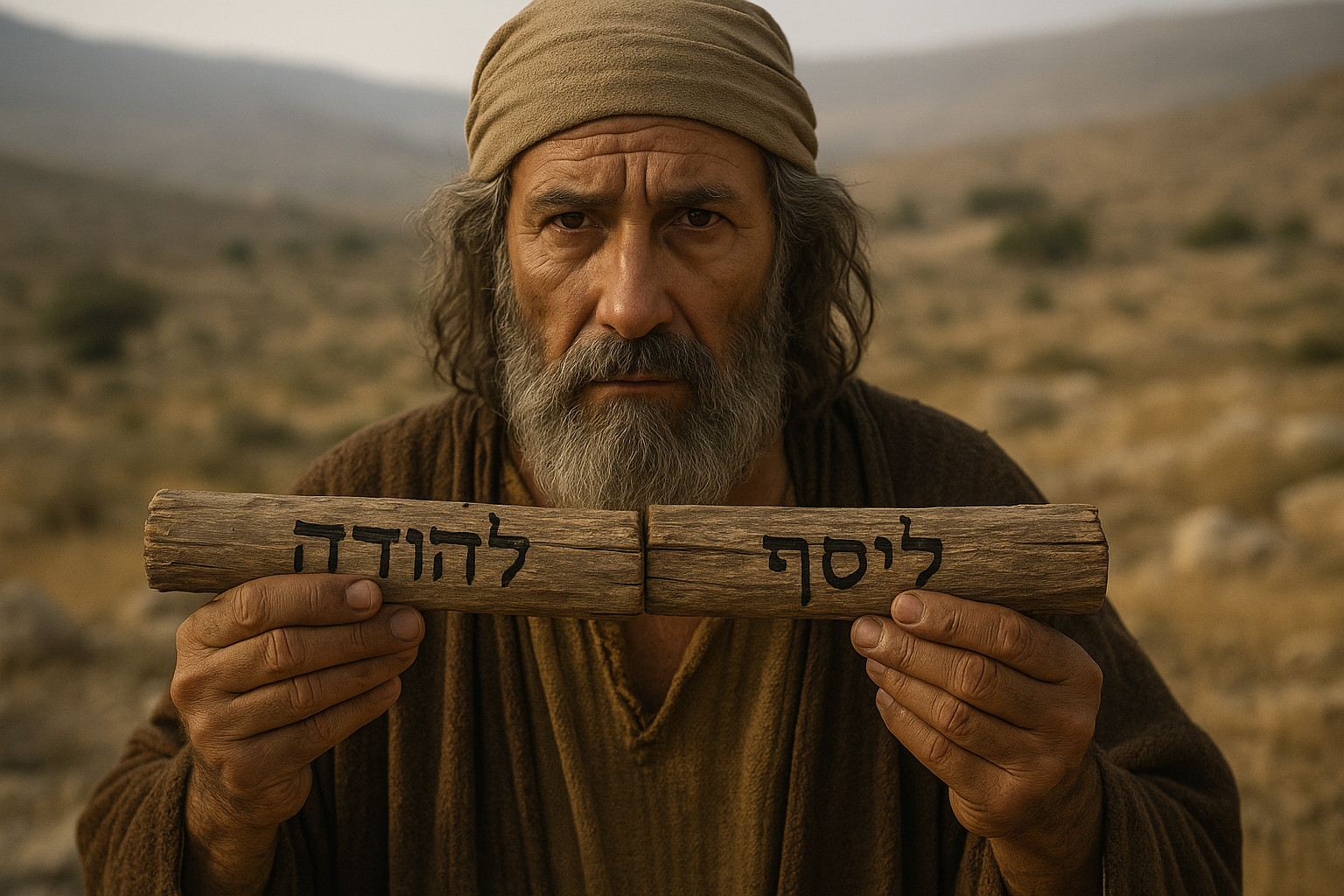
A Future for Israel in Romans 9-11
By Dr. Paul Hartog / March 30, 2026
James Montgomery Boice relayed the account of Frederick the Great, king of Prussia, conversing with his chaplain concerning the reliability of the Scriptures.1 always precedes orthopraxy.2 Correct doctrine always precedes correct practice. No one can function with biblical practice and methodology without first having correct beliefs...
Read More

Fulfilled Messianic Prophecies from the Book of Zechariah
By Dr. Keith Kobelia / September 15, 2025
Among the most intriguing prophetic sections of the Bible are the prophecies of Zechariah which are contained in the book that bears his name. Zechariah is teeming with Messianic prophecies,...
Read More
{"slides_column":1,"slides_scroll":1,"dots":"true","arrows":"true","autoplay":"true","autoplay_interval":"5000","speed":"1200","lazyload":""}
Jesus’ Birth…An Act of God or an Accident of Man
Posted on by Dr. Elvin K. Mattison
Understanding the “how” of Jesus’ coming into this world has been the subject of discussion since the time of Paul the Apostle. Every generation has made an attempt to explain His birth in human terms rather than a miraculous act of God. One school of thought supposes that Joseph and Mary entered into an intimate relationship before their marriage rites were completed and Jesus was born as a result of that action. More recently liberal theologians have speculated that Mary and a German soldier engaged in immoral activity that produced Jesus.
Prophetic Guidelines for the Persian Gulf
Posted on by Dr. Manfred Kober
Like a desert sandstorm, the self-proclaimed master of Mesopotamia swept into Kuwait and came dangerously close to usurping by brute force one half of the world’s oil supply. This swirling storm has meanwhile engulfed the Middle East and may well sweep the rest of the world into its maelstrom. Saddam Hussein’s conquest of Kuwait and threats against Saudi Arabia and Israel graphically demonstrate the volatile nature of the Persian Gulf region. In less than two weeks a multinational army under American command, larger than anything seen since World War II, has been deployed to contain the madman.
The Importance of Water Baptism
Posted on by Dr. Myron J. Houghton
The importance of water baptism has been understood in different ways throughout church history. Some groups have taught that water baptism is the means by which God forgives sins. Others have said that water baptism is a sign and a seal of being in a covenant relationship with God. Obviously this view is much more vague than the first one and allows for differences of interpretation. Yet a third view argues that since water baptism is only a symbol of what God has already done and since water baptism has caused great division within Christendom, either water baptism should not be performed at all or it should be made optional for church membership.
Effective Pastoral Leadership
Posted on by Dr. Robert Domokos
Pastoral leadership is taught in the Bible, and yet it is a topic of frequent, if not fervent, discussion and debate in pastors’ meetings, as well as in church parking lots.
Pastoral leadership must be and can be effective. A thorough understanding of Scripture is important at this point. There must be a proper application and implementation of Scriptural principles.
While there are available many excellent books on the subjects of leadership, administration, and management, some people become frustrated when they are unable to see these subjects presented in their Biblical setting.
Learning From the Closing of Des Moines University
Posted on by Dr. Robert Delnay
On Saturday, September 30, 1989, the alumni of Des Moines University held their last reunion. This might not seem so remarkable, but for the fact that the school closed in 1929. For the last sixty Years the alumni have faithfully commemorated their school. Since now they are all in advanced age, they determined that their sixtieth reunion would be their last. The beautiful shaded campus is long gone with barely a trace. All the old buildings but one have vanished, and you need to look closely to find the one shell that remains.
Prophetic Portents in Eastern Europe?
Posted on by Dr. Manfred Kober
The world has watched with utter amazement the unexpected political changes in Eastern Europe during the final weeks of 1989. Believers are especially interested in what is transpiring. Many of them are enquiring about the prophetic and practical implications of the dramatic developments. In response to numerous questions about the changes and challenges in the Communist camp, the following observations are offered:
I. The Profound Revolution in Communist Countries.
A. Changes in Government:
In a matter of weeks Soviet vassal states have crumbled: Poland fell August 18–19; Hungary, October 7; East Germany, November 9; Bulgaria, November 10; Czechoslovakia, November 29; and Romania, December 22.
The Mosaic Law and National Reconstruction
Posted on by Dr. Ralph G. Turk
There is a movement today identified as Reconstructionism or Dominion Theology that has its roots in postmillennialism. It advocates establishing a theocratic kingdom in America based on the judicial laws of Moses. In fact, by its reasoning, the Christian is under a divine mandate to accomplish this end.
It has been popularized in recent years by Rousas J. Rushdoony in The Institutes of Biblical Law and Greg Bahnsen in Theonomy in Christian Ethics. Out of this has come the Chalcedon school which is a foundation that identifies itself as an independent Christian educational organization.
Volunteers or Draftees?
Posted on by Dr. Robert Delnay
Several times recently I have heard pastors ask for volunteers to take care of certain ministries in the church. While the impulse seems reasonable enough, it deserves some Biblical scrutiny. It is hard to find a passage in the Gospels where Jesus asked for people to come and volunteer their efforts. The accounts we have of his calling disciples come with a command and usually offer a promise, as, “Follow me, and I will make you fishers of men.” He did offer the invitation, “Come unto me, all ye that labor,” but the context offers more rest than ministry.
Shall We Go For Entertainment?
Posted on by Dr. Robert Delnay
Among pastors lately I hear a deep concern for the future of Fundamentalism and of the local church as we have known it. The old patterns do not seem to be working. The growth in numbers of churches in the General Association of Regular Baptists appears to have ended about five years ago, and we seem now to be in a period of negative growth. Of the churches, it is hard to know just what is happening among them, when a third of them do not send in annual reports, but nationwide the average local church seems to be numerically small.
Historic Marks of Fundamentalism
Posted on by Dr. Robert Delnay
Fundamentalism began in the later nineteenth century as a concerned response to the rise of higher criticism and doctrinal deviation and also as a response to the worldly drift among God’s people. How far back does the movement go? Surely not before the Believers’ Meeting held in Chicago, 1875, with their concerns about prophecy and German theology. Some have dated it from 1909, with the publication of The Fundamentals and the first edition of The Scofield Reference Bible. Surely it dates no later than the 1920 Northern Baptist Convention, when Curtis Lee Laws coined the term Fundamentalist.