
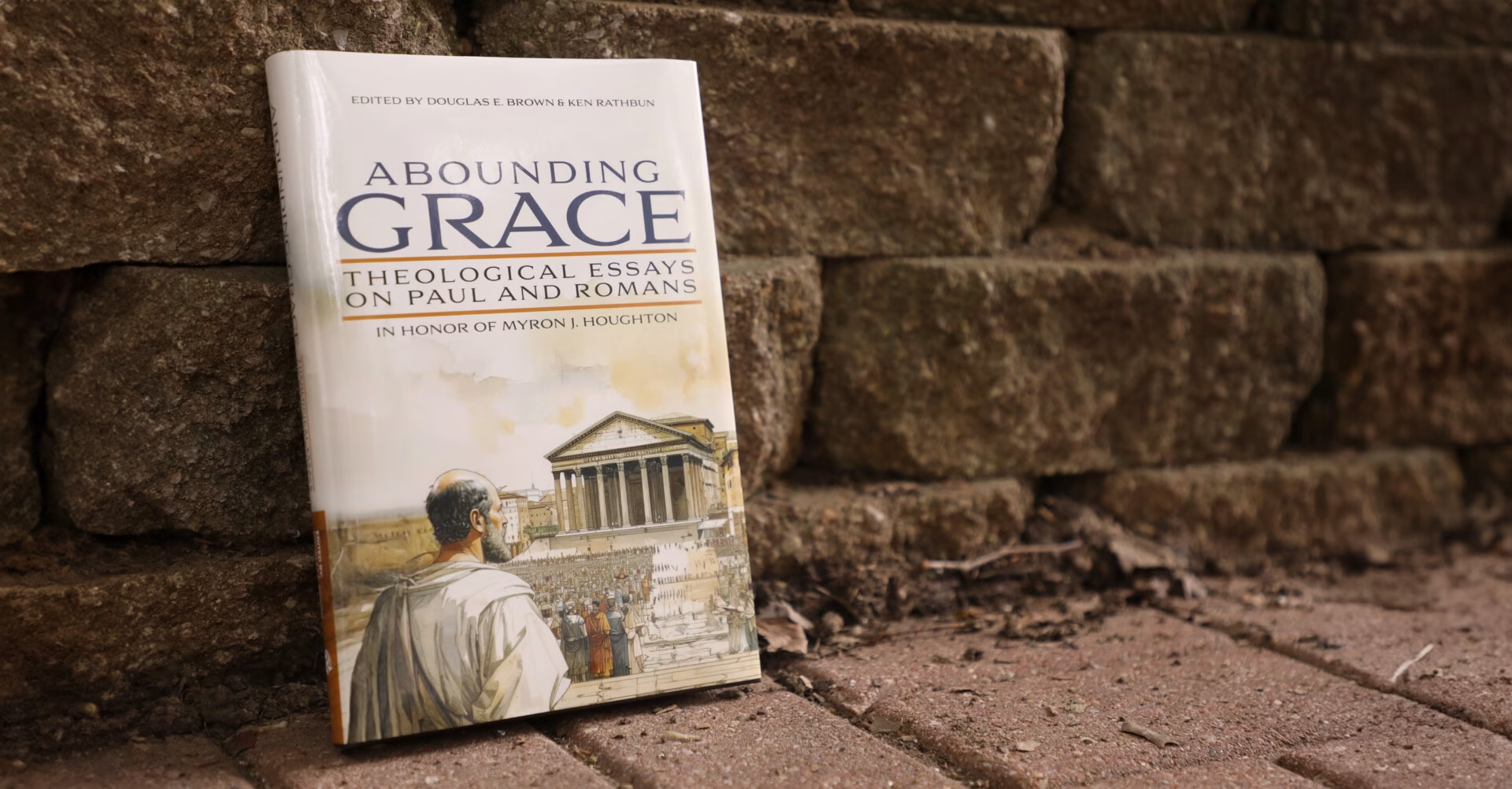
This summer, Faith Baptist Theological Seminary released its newly published book, Abounding Grace: Theological Essays on Paul and Romans in Honor of Myron J. Houghton. This book contains a collection of essays on Romans written by friends and colleagues as a tribute to a man who devoted nearly fifty years of his life to teaching theology. As the preface notes, “Romans had a special place in Dr. Myron’s theology and teaching,” so it is fitting that this festschrift centers on this specific biblical text.
For the alumni who are familiar with Dr. Myron and were his students, the introduction to Abounding Grace provides wonderful reminders of who Dr. Myron J. Houghton was as a person and as a theologian. It also gives unfamiliar readers a glimpse of the quirks, traits, and principles that shaped his personality and ministry. While those familiar with Dr. Myron saw these principles guide his ministry firsthand, reading Abounding Grace will extend Dr. Myron’s influence to those who never knew him.
Unfamiliar readers may also be left in awe: What amazing grace reached into the Houghton siblings’ lives as children! How did Dr. Myron’s childhood or family heritage contribute to his personality? Wouldn’t it be great to hear that laugh? What a privilege it would be to take these theology courses!
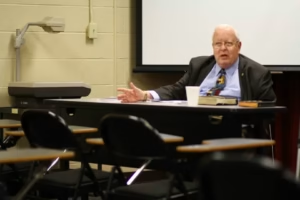 Regarding the principles that guided Dr. Myron’s ministry, a few stand out from the pages of Abounding Grace. First, Dr. Myron did not just love to learn. While Dr. Kevin Bauder writes, “Myron collected diplomas like some people collect stamps,” it was clear to those who knew him that he also understood the importance of ministry and that his diplomas did not merely represent a collection of head knowledge. Because of his many degrees, Dr. Bruce Compton recalls that Dr. Myron earned the nickname “‘Dr. Fahrenheit.’” However, Pastor Lance Augsburger states, “It is important to note that in all his studies, he did not lose sight of the ministry.”
Dr. Bauder also referenced a second principle: Dr. Myron’s belief that being fair to his opponents required an understanding of their beliefs. “As a professor, Myron taught us that we did not understand an opponent until we could describe his position so well that he recognizes himself in it.” Don Anderson wrote that “[h]e pursued degrees from schools of other theological persuasions so he could understand those beliefs.”
A third principle evident in Dr. Myron’s teaching ministry was that he “equipped” his students rather than cloning himself. Kevin Mungons recalls a statement by Dr. Kevin Bauder: “‘[H]e wanted to equip them theologically . . . [and now] there’s a whole generation of pastors who are better equipped to think through the difficult issues that are approaching.’”
Looking past the introduction, why publish another scholarly book on Romans? If you read far enough to discover “the six characteristics of my theology,” as Dr. Mryon called them, you will see that these essays reflect all six characteristics of his theology noted by Dr. Bauder: “exegetical (centered upon the right handling of Scripture), evangelical (gospel-centered), fundamentalist (church-centered), devotional, philosophical, and historical.” The authors of these essays go far beyond a basic introduction to Romans, weaving these six characteristics of theology throughout their writing.
Dr. Alan Cole’s essay on the desperate “plight of fallen humanity” contains the very word “exegetical” in its title. Dr. Bruce Compton’s gospel-centered conclusion to his essay on “Justification by Faith in Paul’s Letter to the Romans” presents “the gospel [as] humanity’s only hope,” while the essays by Dr. Tim Sigler and Dr. Ernie Schmidt revolve around the evangelical message given to both Jews and Gentiles.
Chapters 5, 7, 13, and 14 of Abounding Grace contain church-centered essays by Dr. Mark Swedberg, Dr. Paul Hartog, Dr. Rob Clark, and Dr. Daniel Brown. These essays focus on the themes of sanctification and godly living under grace, the law of Christ, welcoming one another while maintaining church unity, and instructions for ministry in today’s church.
Dr. Timothy Little provides an essay on devotional living in response to “the mercies of God” detailed in Romans 12. Abounding Grace also offers a philosophical approach in chapter 8 through an essay by Dr. Keith Kobelia, which includes his conclusion regarding the person referred to in Romans 7, along with practical implications. This philosophical approach continues in chapter 9 with Dr. Kevin Bauder’s essay titled “Eternal Security, Assurance, and Perseverance.”
Finally, the historical characteristic of Dr. Houghton’s theology is reflected in chapters 2 and 6. “The Occasion and Purposes of Romans” by Dr. Douglas Brown provides immense historical background on the book of Romans. The essay titled “Romans 6 and Baptism” by Dr. Ken Rathbun offers historical explanations of infant baptism and further develops the concepts from this specific text of Scripture.
All thirteen essays point back to at least one of the six characteristics of Dr. Myron’s theology. While single aspects of each essay have been highlighted, readers will discover that many of these essays reflect multiple, overlapping characteristics of his theology.
As noted in the preface, it is the desire of the editors, Dr. Douglas Brown and Dr. Ken Rathbun, that readers will “better grasp ‘the depth of the riches and wisdom and knowledge of God’ (Rom 11:33).” As Dr. Daniel Brown later states, “What one believes in doctrine will always determine one’s actions in practice. It is, therefore, critical that the believer has the correct doctrinal basis before attempting to serve the Lord. Wrong theology inevitably leads one into wrong practice.”
And practice is what Dr. Myron Houghton did. After all, as Pastor Augsburger summarizes, “. . . books and learning without the opportunity to minister the Word to people in desperate need of a right understanding of Scripture, and a right relationship with God” are useless.
May the pages of Abounding Grace facilitate a deeper knowledge and worship of our great God!